


By Hemang Jain · Reviewed by Dr. Tanvi Sehgal, MD · Last updated: 2026-05-02
What this means for you
If your body wash leaves skin tight or itchy after a shower, pH is the most likely culprit — switch to a wash labelled pH 5.5 and reassess after one week.
Your skin has a pH. Most body washes ignore it. That mismatch is the reason your skin feels tight after every shower, dulls instead of glowing, and reacts to products that used to feel fine.
This guide explains what skin pH actually is, why 5.5 is the number that matters, and how to check whether your body wash is working with your skin or against it.
What is skin pH — and why does it matter?
The pH scale runs from 0 (acidic) to 14 (alkaline), with 7 as neutral. Pure water sits at 7. Lemon juice at 2. Soap at around 9 to 10.
What this means for you
If your body wash leaves skin tight or itchy after a shower, pH is the most likely culprit — switch to a wash labelled pH 5.5 and reassess after one week.
Healthy human skin sits between 4.5 and 5.5 — mildly acidic.
This acidity is not accidental. It is engineered by your body to do three specific jobs:
- Bacterial defence. Most pathogenic bacteria cannot thrive in acidic environments. Your skin's pH is a passive immune system.
- Enzyme function. The natural enzymes in your skin that maintain barrier integrity are pH-dependent. They only work properly in mildly acidic conditions.
- Barrier integrity. The lipids that hold your stratum corneum (outer skin layer) together require a specific pH to stay structured. Shift the pH and the bricks-and-mortar barrier loosens.
A 2014 study in NCBI PMC found that South Asian skin averages a surface pH of 5.0 — even slightly more acidic than the global average. Indian skin, in other words, is finely calibrated for a specific pH zone.
The acid mantle — your skin's invisible shield
The thin film that creates this acidic surface has a name: the acid mantle. It is made of three things:
What this means for you
If your body wash leaves skin tight or itchy after a shower, pH is the most likely culprit — switch to a wash labelled pH 5.5 and reassess after one week.
- Sebum — the oil your sebaceous glands produce
- Sweat — including the lactic acid and amino acids it carries
- Natural moisturising factors (NMFs) — small molecules that hold water in the outer skin
This invisible layer is your first line of defence against:
- Bacteria and pathogens — kept out by the acidic environment
- Pollution and irritants — held at the surface, not allowed to penetrate
- Trans-epidermal water loss (TEWL) — the technical term for moisture evaporating from your skin
When the acid mantle is disrupted, all three protections fail. The visible signs are familiar: dryness that no lotion seems to fix, sensitivity to products that used to feel fine, blotchy pigmentation, eczema flares, recurring fungal acne on the body.
One thing worth noting for Indian context: humidity does not mean your skin is hydrated. Indian summers and monsoons have 70%+ ambient humidity, which feels wet on the surface — but if your acid mantle is damaged, your skin is losing moisture from inside even while the air feels saturated. Barrier damage looks different in tropical climates than in dry ones, and it is often missed.
How body wash pH affects your skin
Now the math gets uncomfortable. Compare typical product pH ranges to your skin's 5.5:
- Bar soaps: pH 9 to 10 (highly alkaline — 5,000× more alkaline than skin)
- Conventional body washes (with SLS): pH 6.5 to 8
- "Mild" body washes: often still pH 6 to 7
- pH-balanced body washes: pH 5.5 (matched to skin)
What an alkaline cleanser does in a single shower:
- Strips the lipid layer that holds the acid mantle together
- Raises skin's surface pH for up to 2 hours after rinsing
- Increases TEWL (water loss from skin) by up to 30% within one wash, per multiple barrier-function studies
- Disrupts the bacterial balance that protects against acne and infection
The skin barrier takes 4 to 6 hours to recover — minimum. For Indian women who shower twice a day in summer (most of us), the barrier never fully recovers. You are washing again before the lipids have re-knitted.
This is why the same body wash that "works fine" for someone in Berlin will leave Mumbai or Delhi skin feeling stripped. The product is identical. The frequency of insult is double.
What pH 5.5 means in a body wash
A pH 5.5 body wash is formulated to match your skin's natural acidity exactly. This is not marketing language — it is a measurable formulation choice.
Three things have to be true for a body wash to actually be pH 5.5:
1. Mild surfactants instead of SLS or SLES. The big-foam sulfates work by raising the pH of the cleansing solution. To formulate at pH 5.5, you need gentler alternatives — sodium cocoyl isethionate, coco glucoside, lauryl glucoside. We covered the chemistry in how SLS disrupts skin pH.
2. A pH-buffering system. Even with mild surfactants, the formulation needs an acid-base buffer (typically citric acid or lactic acid) to lock the pH at 5.5 across the product's shelf life. Without buffering, the pH drifts.
3. Verified pH testing on every batch. A claim of pH 5.5 means nothing if it is not measured on every production batch. Rigorous brands include batch-level pH testing as part of QC.
"A body wash formulated at pH 5.5 is not a luxury — it is the baseline standard for skin that does not react. Most of the body care problems I treat in clinic disappear within two months when the patient switches to a properly pH-balanced cleanser. The acid mantle does most of the work if you let it."
— Dr. Tanvi Sehgal, MD, Dermatologist
The Love Co formulates every body wash at pH 5.5 — measured, batch-tested, dermatologist-endorsed. It is the formulation standard the brand was built around.
How to check if your body wash is pH balanced
You do not have to take any brand's word for it. The test is simple and at-home:
The pH strip test (5 minutes, ₹150 from any chemist):
- Buy a pack of universal pH test strips (range 0 to 14)
- Squeeze a small amount of body wash onto a clean surface
- Add 2 drops of distilled water and stir to dissolve
- Dip a strip for 2 seconds, remove, wait 30 seconds
- Compare the colour to the chart on the strip box
Anything above 6 means the body wash is more alkaline than your skin can handle daily. Anything between 5 and 6 is acceptable. Exactly 5.5 is the gold standard.
Reading the label: Absence of "sodium lauryl sulfate" or "sodium laureth sulfate" in the first 5 ingredients is a strong proxy for pH-balanced formulation. Look for "pH balanced" or "pH 5.5" called out explicitly on the bottle. Generic "dermatologist-tested" without a stated pH is weaker — many alkaline body washes are also dermatologist-tested.
If you are upgrading your routine, the order matters:
- Start with the cleanser. Switching to pH 5.5 body wash undoes more damage than any moisturizer can fix. Shop pH 5.5 body wash first.
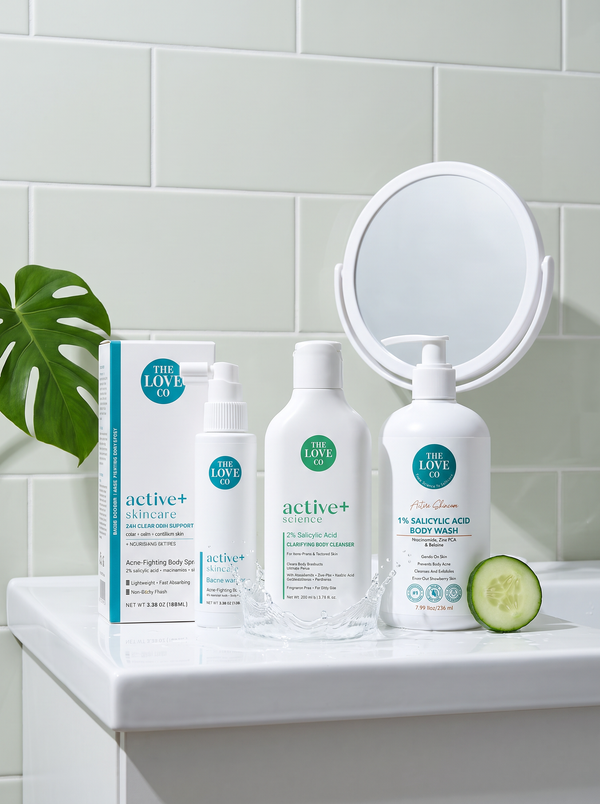
- For dry skin: pair with a SLS-free body wash for dry skin with added humectants.
- For sensitive or reactive skin: a SLS-free body wash for sensitive skin with low fragrance is the safest start.
- For the full picture: read our complete guide to the best pH-balanced, SLS-free body wash in India.
Related concepts
- Acid mantle — The thin protective film of sebum, sweat, and natural moisturising factors on healthy skin's surface, maintaining a pH of 4.5 to 5.5.
- Trans-epidermal water loss (TEWL) — Water vapour passing from inside the body through the skin's outer layers; rises sharply when the acid mantle is disrupted.
- Surfactant — A cleansing molecule that lifts oil and dirt; harsh anionic surfactants like SLS strip lipids alongside grime.
- Stratum corneum — The outermost 10–20 cell layers of skin where the lipid barrier sits; the first structure damaged by alkaline cleansers.
- Syndet — Synthetic detergent bar or wash formulated at skin-friendly pH, in contrast to true alkaline soap.
FAQ
What pH should a body wash be?
A body wash should match your skin's natural pH of 5.5. Anything between 5 and 6 is acceptable for daily use. Above 6 is too alkaline for daily use on Indian skin, especially in twice-daily showering climates. Above 7 is actively damaging the acid mantle every wash.
Is pH 5.5 body wash safe for daily use?
Yes — that is the point. A pH 5.5 body wash is formulated specifically to be used daily without disrupting the acid mantle. The reason most body washes are restricted to "occasional use" or "for resilient skin" is that they are NOT pH-matched.
Can I use a pH-balanced body wash on my face?
Sometimes, but cautiously. Facial skin is thinner and more sensitive than body skin, and many pH 5.5 body washes still contain surfactants that are too active for facial use. Stick to a face-specific cleanser for the face. The pH match is necessary but not sufficient.
Does pH-balanced mean fragrance-free?
No. pH and fragrance are unrelated. A pH 5.5 body wash can absolutely be fragrance-led — you just need the fragrance components to be added in a way that does not shift the formulation pH. The Love Co's fragrance-led range is all formulated at pH 5.5.
Is Sebamed the only pH 5.5 body wash in India?
No — though Sebamed pioneered pH 5.5 in India. Today multiple Indian brands formulate at pH 5.5, including The Love Co (the entire body wash range), and selected Cetaphil and CeraVe products. The category is growing as Indian consumers learn to ask for pH on the label.
Your body wash should work with your skin, not against it.
Shop SLS-free, pH 5.5 body wash →
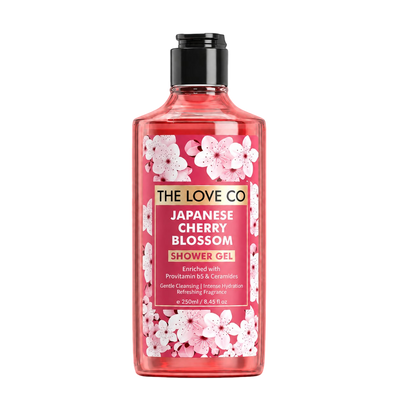
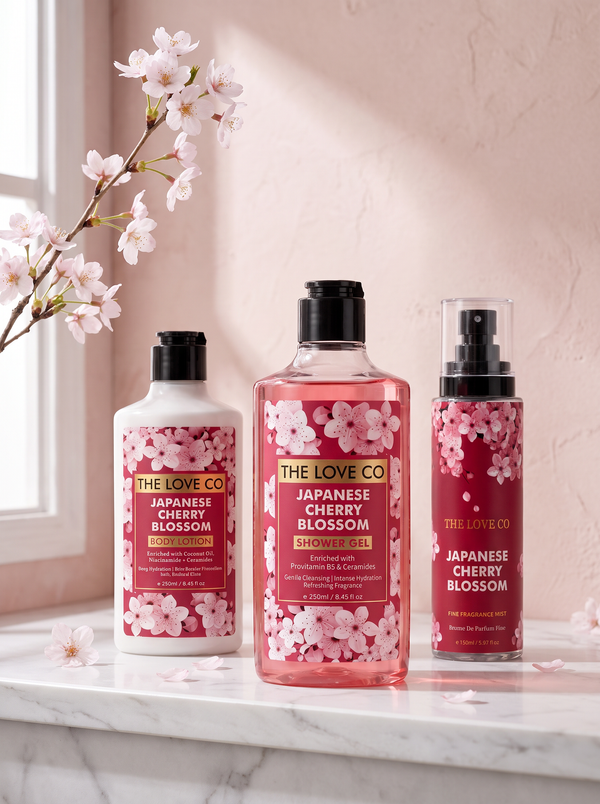
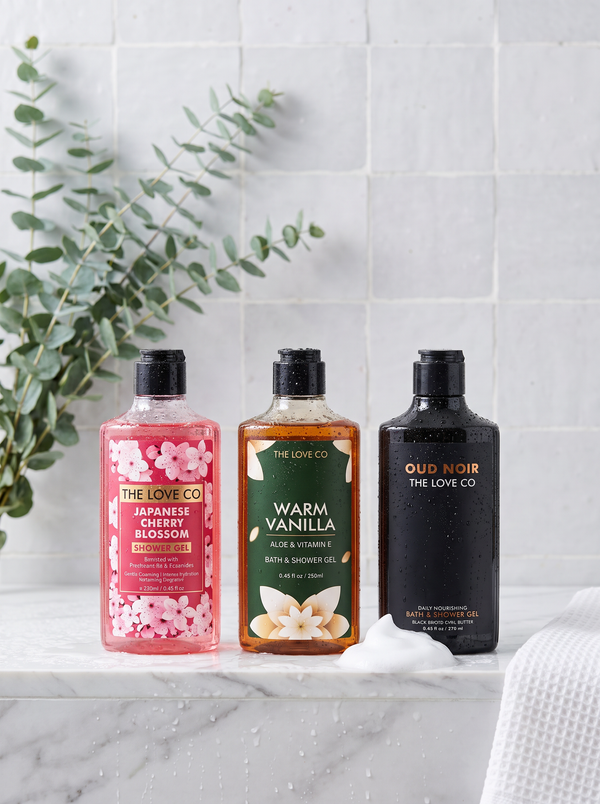
Japanese Cherry Blossom Shower Gel
Scent Trail Step 1 · soft floral body wash Start the Scent Trail here. A pH 5.5, SLS-free cleanser that protects your skin barrier while it washes —...
A ritual is the smallest love you give yourself, daily.
— Hemang Jain · 01 May 2026