You've seen both names on every "hydrating" label from Bandra to Banjara Hills. Urea. Hyaluronic acid. Both promise the same thing — plumper, softer, less-thirsty skin. But if you've ever stood in a chemist's aisle wondering which one your dry shins actually need in a Mumbai monsoon, the answer isn't "either." It's "it depends, and here's why."
This is the honest, dermatologist-leaning breakdown for Indian skin and Indian weather — without the marketing fog.
What a humectant actually does
A humectant is an ingredient that pulls water toward itself. On your skin, that means drawing moisture from the deeper layers (dermis) and from humid air, and binding it inside the upper layer (stratum corneum). Both urea and hyaluronic acid (HA) are humectants. That's where the similarity ends.
The difference lies in how they hydrate, how deeply they go, and what bonus actions they bring along.
How hyaluronic acid works on Indian skin
HA is a sugar molecule your body already produces — it's in your joints, eyes, and skin. As a topical, HA can hold up to 1,000 times its weight in water. It pulls moisture from two sources: the atmosphere around you (when humidity is >50%, common in coastal India) and from deeper skin layers.
This makes HA brilliant for Indian summers and monsoons, when ambient humidity is high. It plumps surface skin within minutes — great for that smooth, glassy finish before makeup or in the morning.
The catch: in dry winter Delhi or air-conditioned offices in Bengaluru, HA can actually pull water out of your skin (toward the dry air) if you don't seal it with a moisturizer or oil on top. HA needs a partner.
How urea works on Indian skin
Urea is a small molecule naturally present in your skin's Natural Moisturizing Factor (NMF). At low concentrations (5–10%), it acts as a humectant, locking water into the stratum corneum. At higher concentrations (15%+), it becomes keratolytic — meaning it loosens dead skin cells and dissolves the protein bonds holding rough patches together.
This is the bonus HA simply doesn't have. Urea hydrates and exfoliates. For thick, callused skin on heels, elbows, and knees — the kind almost every Indian adult develops from open footwear and floor-sitting culture — urea is the smarter humectant.
Side-by-side: what to choose, when
| Concern | Better Choice | Why |
|---|---|---|
| Smooth, plump face skin | Hyaluronic acid | Lightweight, non-keratolytic, won't sting |
| Cracked heels, rough elbows | Urea (10–25%) | Exfoliates dead skin while hydrating |
| Eczema, KP, ichthyosis | Urea (5–10%) | Restores NMF, dermatologist-recommended |
| Daily body lotion, all-over | Urea (5%) | Tolerable, hydrating, mild smoothing |
| Layering under serum/SPF | Hyaluronic acid | Absorbs fast, no residue |
| Diabetic dry skin | Urea (10%, dermatologist guidance) | Restores barrier without occlusion |
The myth of "either / or"
The smartest formulations use both. HA pulls water rapidly to the surface, urea binds it in for the long haul and gently smooths roughness. If you have severely dry, textured Indian skin, look for a body lotion that combines them — or layer an HA serum under a urea body lotion.
Dr. Tanvi Sehgal, MD on humectant pairing
"In my Indian patients, I rarely choose between urea and hyaluronic acid — I sequence them. HA for the face, urea for the body. For very dry, textured limbs, both ingredients in one formulation outperform either alone. The keratolytic action of urea is what HA cannot replicate, and that matters for the kind of cumulative roughness our climate produces." — Dr. Tanvi Sehgal, MD, Consulting Dermatologist
FAQ
Q1: Can I use urea and hyaluronic acid together?
Yes. They're complementary. Apply HA first (lighter), urea body lotion or cream on top.
Q2: Which is better for sensitive skin?
Hyaluronic acid is gentler. Start with 5% urea if you want urea benefits without irritation. See our sensitive skin body wash guide.
Q3: Does urea exfoliate the face?
At higher concentrations, yes — but most people find face-strength urea (5–10%) gentler than AHAs.
Q4: Will HA work in dry Delhi winter?
Only if sealed with a moisturizer or oil on top. Otherwise it can dehydrate skin.
Q5: Which is better for keratosis pilaris (KP)?
Urea, hands down. Its keratolytic action targets exactly what KP needs. Browse our dryness collection.
Explore our full body lotion range and richer body butters. For sensitive routines, see our sensitive skin edit or compare with our dry-skin body wash guide.
Stop choosing. Start layering. Build a routine with HA for plump and urea for smooth — shop body lotion now.
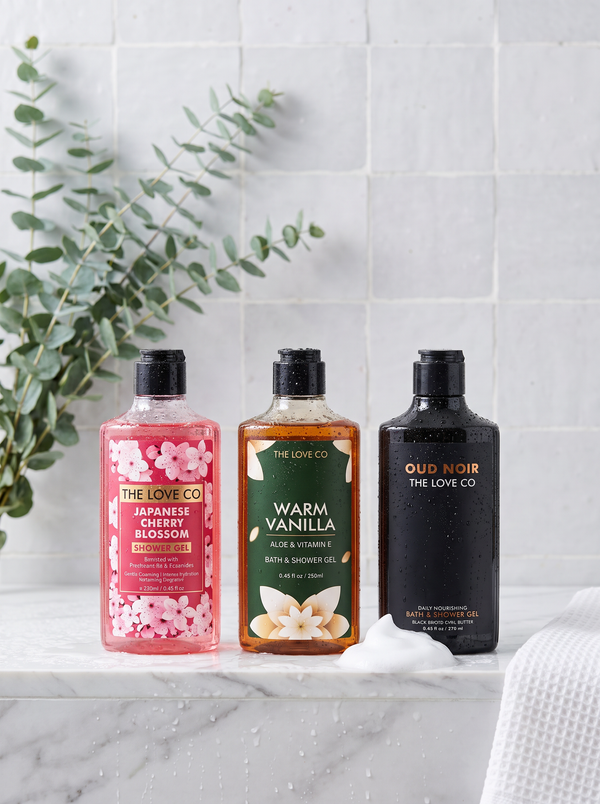
Japanese Cherry Blossom Shower Gel
Scent Trail Step 1 · soft floral body wash Start the Scent Trail here. A pH 5.5, SLS-free cleanser that protects your skin barrier while it washes —...
A ritual is the smallest love you give yourself, daily.
— Hemang Jain · 03 May 2026