














This is a general summary of the position as commonly applied for the 2026–27 financial year. It is not tax advice. Thresholds, rates and interpretation change, and treatment depends on the specific facts of your arrangement. Confirm with your chartered accountant before finalising a large gifting programme.
Most corporate gifting budgets are wrong by about 18%, and it is always the same mistake.
Someone models the programme net of GST, on the reasonable assumption that GST paid on a business purchase is recoverable. For almost every other line item in a company's spending, it is. For gifts, it is not.
Here is the full picture, in the order finance will ask about it.
1. The GST rate on the goods
Corporate gifts are taxed at the rate applicable to what is inside the box.
- Body care, fragrance, cosmetics, soaps: 18%
- Most confectionery and dry fruit: varies by item and packaging
- Textiles and apparel: varies by value threshold
- Electronics and accessories: commonly 18%
This is the first practical argument for a single-category hamper. A mixed hamper containing body care, tea, chocolates and a diary may span three or four GST rates, which means the invoice must be split by HSN classification. Your finance team will insist on this, and a vendor who cannot produce it will delay your payment run.
Ask for HSN codes stated per line on the quote, not just on the final invoice.
2. Input tax credit is blocked
This is the provision that surprises people, and it is the single most expensive thing to learn late.
Section 17(5)(h) of the CGST Act blocks input tax credit in respect of "goods lost, stolen, destroyed, written off or disposed of by way of gift or free samples."
Gifts are explicitly named. The GST you pay on a corporate gifting order is not recoverable as ITC.
What that means in practice:
On a ₹5,00,000 gifting order at 18%, the GST is ₹90,000. In an ordinary business purchase you would set that against your output liability. Here you cannot. Your true cost of the programme is ₹5,90,000, not ₹5,00,000.
Budget the GST inside the per-head number, not outside it. A per-head budget of ₹1,000 does not buy a ₹1,000 gift. It buys roughly an ₹847 gift plus GST, before you have spent anything on branding or freight.
This is also why a "GST extra" quote and a "GST inclusive" quote are not comparable, and why the comparison should always be run on landed cost.
3. The ₹50,000 employee gift threshold
Schedule I, paragraph 2 of the CGST Act treats certain transactions as a supply even when made without consideration. The relevant one:
"Gifts not exceeding fifty thousand rupees in value in a financial year by an employer to an employee shall not be treated as supply of goods or services."
Read the negative: gifts exceeding ₹50,000 in a financial year, to a single employee, are treated as a supply — and GST becomes payable by the employer on that supply.
Three things people get wrong about this threshold:
It is aggregate, not per gift. All gifts to that employee across the financial year are added together. A Diwali hamper, a work anniversary gift, a wedding gift and a milestone award are one running total.
It is per employee, per financial year. Not a company-wide cap. You are tracking each individual.
It is a cliff, not a slab, in the way most people first read it. Once the aggregate exceeds ₹50,000, the exemption in Schedule I no longer applies to that gifting. Treatment of the excess versus the whole is a point on which professional advice genuinely matters — ask your CA specifically about this rather than assuming.
For the overwhelming majority of corporate gifting programmes — a ₹600 Diwali gift and a ₹1,500 welcome kit — this threshold is nowhere in sight. It becomes live for long-service awards, senior leadership gifting and high-value recognition programmes, which are exactly the programmes companies run without checking.
4. The ₹5,000 perquisite limit — the employee's side
This is a different tax, on a different person, under a different Act, and it is routinely confused with the ₹50,000 rule.
Under Rule 3(7)(iv) of the Income Tax Rules, the value of any gift, voucher or token received by an employee from an employer is taxable as a perquisite where the aggregate value exceeds ₹5,000 in a financial year. Below that, it is exempt.
What that means:
- A ₹600 Diwali gift: no perquisite issue.
- A ₹1,500 welcome kit plus a ₹600 Diwali gift plus a ₹3,500 long-service gift: aggregate ₹5,600, which crosses the threshold and becomes taxable in the employee's hands.
The employee pays this, through payroll, at their slab rate. Which means a generous recognition gift can arrive with a small tax bill attached — and the employee will not have been expecting it.
Practical guidance: if your total annual gifting to an individual is approaching ₹5,000, tell payroll. And consider telling the employee. A gift that quietly increases someone's tax deduction two months later is a worse experience than a smaller gift would have been.
Note on cash and vouchers. Cash gifts are fully taxable as salary regardless of amount. Vouchers are covered by the ₹5,000 aggregate rule. Gifts in kind are covered by the same rule. This is one of several reasons physical gifts and vouchers are not interchangeable from a tax standpoint.
5. Gifts to clients and non-employees
Different provision again.
Under Section 56(2)(x) of the Income Tax Act, a person receiving property without consideration is taxed where the aggregate value from non-relatives exceeds ₹50,000 in a financial year. In practice, ordinary business gifting to clients rarely approaches this per-recipient, and gifts received in the course of business have their own treatment.
The more common issue for client gifting is on your side, not theirs: whether the expense is allowable as a business deduction. Corporate gifting to clients is generally treated as a business promotion expense where it is genuinely incurred for business purposes and properly documented — invoice, recipient list, business rationale.
Keep the recipient list. It is the documentation that makes the expense defensible, and it takes ten minutes to produce at the time and considerably longer to reconstruct two years later.
Worked example: a 400-person Diwali programme
| Line | Amount | Notes |
|---|---|---|
| 400 gift sets @ ₹629 | ₹2,51,600 | Body care, single category |
| Branding and packaging | ₹26,000 | Printed sleeve + card |
| Freight (bulk drop) | ₹6,000 | Single office |
| Sub-total | ₹2,83,600 | |
| GST @ 18% | ₹51,048 | Not recoverable — Sec 17(5)(h) |
| Total cost | ₹3,34,648 | |
| Per head | ₹837 |
Employee-side check: ₹629 per person is well under the ₹5,000 perquisite threshold and nowhere near the ₹50,000 Schedule I threshold. No further action needed — unless the same employees also receive other gifts during the year, in which case aggregate and re-check.
Illustrative figures. Branding and freight are indicative category rates.
The three things to tell your CA
If you take one thing from this article into a conversation with your accountant, take these three questions:
- "We are giving gifts, so ITC is blocked under 17(5)(h) — confirm we should budget GST as a cost?"
- "Can you check our aggregate per-employee gifting against the ₹50,000 Schedule I threshold and the ₹5,000 perquisite limit for this financial year?"
- "Is our client gifting documented sufficiently to be allowable as business promotion?"
Those three questions cover the large majority of corporate gifting tax exposure in India, and all three are cheaper to ask in August than in March.
Frequently asked questions
Is GST applicable on corporate gifts in India? Yes. GST applies at the rate for the underlying goods — 18% for body care, fragrance and cosmetics. Additionally, gifts to an employee exceeding ₹50,000 in aggregate in a financial year are treated as a supply under Schedule I of the CGST Act.
Can input tax credit be claimed on corporate gifts? No. Section 17(5)(h) of the CGST Act specifically blocks ITC on goods disposed of by way of gift or free sample. The GST paid is an unrecoverable cost and should be budgeted as such.
What is the ₹50,000 gift limit under GST? Under Schedule I of the CGST Act, gifts from an employer to an employee not exceeding ₹50,000 in value in a financial year are not treated as a supply. Above that aggregate, GST implications arise for the employer.
Are employee gifts taxable in the employee's hands? Gifts, vouchers and tokens from an employer are taxable as a perquisite where the aggregate value exceeds ₹5,000 in a financial year, under Rule 3(7)(iv) of the Income Tax Rules. Cash gifts are fully taxable as salary regardless of amount.
Is corporate gifting to clients tax deductible in India? Client gifting is generally treated as a business promotion expense where genuinely incurred for business purposes and properly documented with invoices, a recipient list and a stated rationale.
Do mixed hampers create a GST problem? They can. A hamper spanning body care, food and textiles may cross multiple GST rates and requires HSN-wise invoicing. Single-category hampers avoid the classification issue entirely.
Practical takeaway
Related: what corporate gifting actually costs per employee — the worked budgets there already include the unrecoverable GST.
Add 18% to your per-head budget and treat it as spent. Track aggregate gifting per employee across the financial year, not per occasion. Keep the recipient list.
For GST-compliant, HSN-classified quotes on single-category body care gifting, talk to The Love Co.'s corporate team or browse the corporate range.
Again: general information, not tax advice. Confirm with your CA.
The finance controller signs it off on a Thursday evening with one line added to the note: "GST unrecoverable — costed in." It is eleven words, and it is the reason nobody has to have a difficult conversation in March.
Somebody, somewhere in that building, will open a box in October and not think about any of this. That is the point of doing it properly.
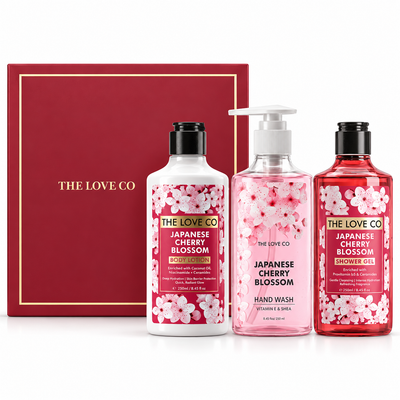
Japanese Cherry Blossom Trio Gift Set
The full Sakura trio.Three full-size Japanese Cherry Blossom essentials — the complete three-step Sakura ritual in one gift box.The ritualWash → lotion on damp skin → mist on...
A ritual is the smallest love you give yourself, daily.
— Hemang Jain · 26 Aug 2026