

Glycolic acid was the first AHA to enter Indian beauty consciousness, mostly through dermatologist-prescribed peels in the early 2000s. Twenty years later it is in face washes, body washes, toners, serums, and exfoliating pads at every Indian retail price point. But most consumers still do not know what makes a glycolic body wash work versus a marketing label.
This guide is built from how Dr. Tanvi Sehgal MD prescribes glycolic to her patients in Mumbai and how The Love Co. founder Hemang Jain formulates glycolic into fragrance-led body washes that actually perform in Indian water and weather.
Why Glycolic Acid Works So Well
Glycolic acid is the smallest AHA molecule (molecular weight 76 Da)—smaller than lactic, much smaller than mandelic. Small means fast penetration. It dives into the stratum corneum, breaks the corneodesmosome bonds holding dead cells together, and reveals fresher skin underneath. The result on body skin: less dullness, lighter post-acne marks, smoother texture on arms and legs, and noticeably brighter shins.
The trade-off is that the same small molecule that delivers fast results also penetrates deep enough to irritate compromised skin. So formulation discipline matters.
Glycolic Body Wash vs Glycolic Serum
| Body Wash | Leave-On Serum/Lotion | |
|---|---|---|
| Contact time | 30–60 seconds | 8–12 hours |
| Concentration | 5–10% | 5–15% |
| Daily safety | Most skin types | Often too aggressive |
| Best use | Maintenance, prevention | Targeted spot treatment |
Body wash is the better starting point. Short contact time means low irritation risk, and you cover large surface areas (back, legs) that no one realistically applies a serum to.
What to Look For on the Label
Glycolic acid should appear in the top half of the ingredient list—ideally in the first six ingredients after water. The formulation should declare a pH between 3.5 and 4.5; anything higher is buffered into ineffectiveness. Look for sulfate-free or low-sulfate bases—our SLS in body wash guide explains why this matters in Indian hard water cities.
Avoid formulations that combine glycolic with physical scrub beads or walnut shell powder. Layered exfoliation is how barriers break.
"Glycolic is the most over-prescribed and most poorly explained AHA in India. Patients use it daily, then complain of redness and breakouts—which is the barrier collapsing, not a side effect of the acid. The protocol I give every glycolic patient: three nights a week, follow with a ceramide moisturizer, and SPF every single morning. Compliance with that protocol determines whether glycolic transforms their skin or destroys it."
— Dr. Tanvi Sehgal, MD (Dermatology), TLC Dermatology Partner
Indian Climate Considerations
Glycolic acid increases UV sensitivity by up to 50% in the 24 hours after use. In Indian conditions—where UV index hits 11+ in Delhi summers and Chennai year-round—this is not optional information. Apply broad-spectrum SPF 30+ to body skin you will expose: forearms, neck, décolletage, calves.
Hard water (TDS above 300 ppm, common in Bengaluru, Hyderabad, parts of Delhi NCR) raises the effective pH of any rinse-off product. If you are in a hard-water city, you may need a slightly stronger formulation to compensate, or filter your shower head.
How to Build a Glycolic Body Routine
Week 1–2: Use twice a week, evening only. Patch test inside the elbow first.
Week 3–4: Increase to three times a week if no irritation.
Maintenance: 3–4 times a week is the sustainable ceiling for most users.
Always pair with a barrier-supporting moisturizer—ceramides, niacinamide, glycerin. And read our pH-balanced body wash guide to understand why the wash that follows on rest days matters.
Who Should Skip Glycolic
If you have very sensitive skin, eczema-prone body skin, active rosacea on the chest or back, or Fitzpatrick V–VI skin with a history of post-inflammatory hyperpigmentation, mandelic acid is a smarter starting AHA. Read more in our main AHA cluster guide.
For those on isotretinoin (Sotret, Saslic) or recent chemical peels, skip all body acids entirely until your derm clears you.
The TLC Approach
We formulate glycolic at 7%, pH 4.0, in a sulfate-free fragrance-led base. The fragrance is not optional—it is the reason TLC exists. We refuse to ship a clinical-smelling glycolic wash when sensory experience determines whether you actually use it consistently.
Browse our AHA/BHA collection or our broader exfoliating range.
Frequently Asked Questions
Is glycolic acid body wash safe for daily use in India?
For most non-sensitive skin, 3-4 times per week is the sweet spot. Daily use can compromise the barrier in low-humidity North Indian winters. In Mumbai or Chennai humidity, alternate days is safer.
What percentage of glycolic acid should an Indian body wash have?
5–10% is the effective range for body skin. Below 5% does little; above 10% is leave-on territory and not safe in a rinse-off wash for daily users. Most TLC-grade formulations sit at 7–8%.
Will glycolic acid lighten my skin tone?
It does not bleach. It evens tone by accelerating shedding of pigmented dead cells, which fades post-acne marks and tan. It will not change your underlying melanin or complexion.
Can I use glycolic body wash on my face?
Body wash glycolic is too harsh for the thinner facial skin barrier. Use a face-specific glycolic cleanser at lower percentage and shorter contact time.
Why does glycolic body wash sting more in winter?
Lower humidity means a more compromised skin barrier, so the acid penetrates faster and stimulates more nerve endings. Reduce frequency to twice weekly in December–February if you live in Delhi, Punjab, or the hills.
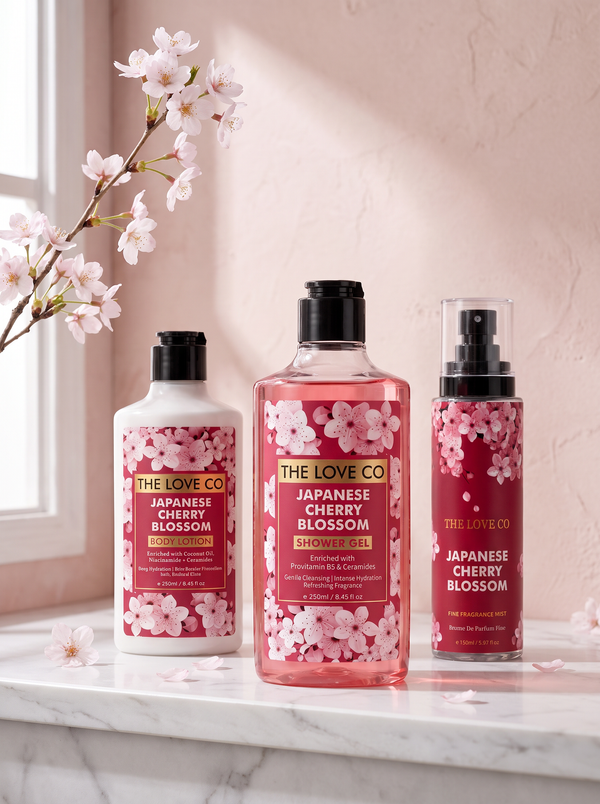
Japanese Cherry Blossom Shower Gel
Scent Trail Step 1 · soft floral body wash Start the Scent Trail here. A pH 5.5, SLS-free cleanser that protects your skin barrier while it washes —...
A ritual is the smallest love you give yourself, daily.
— Hemang Jain · 03 May 2026