
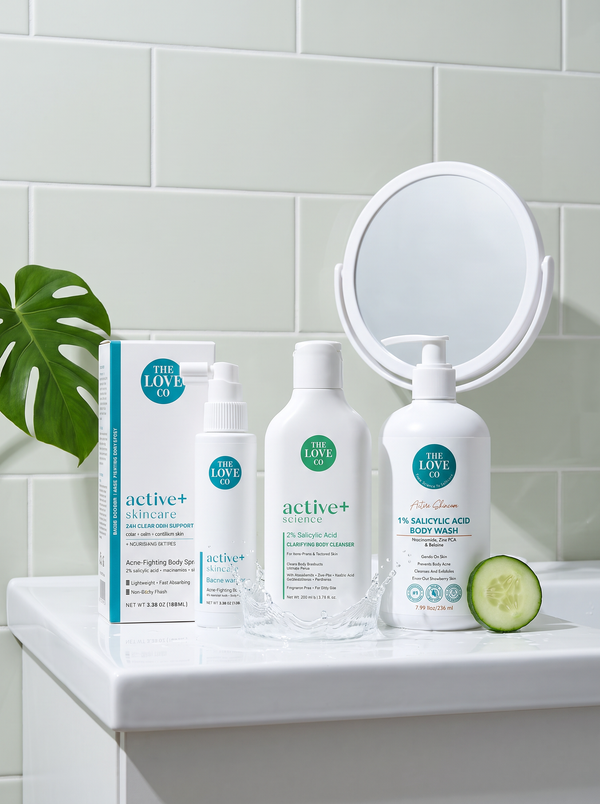
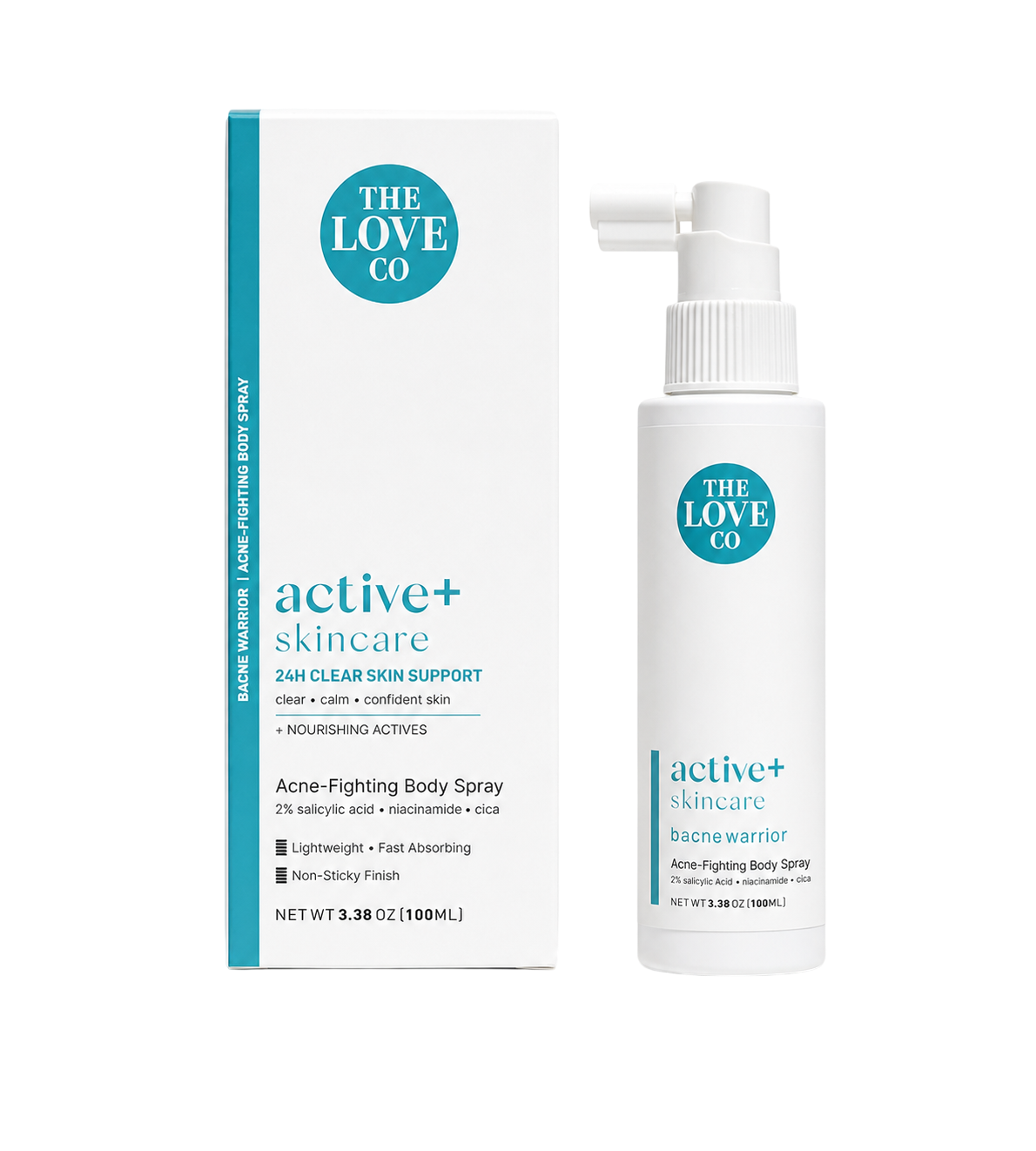
A body acne spray is a leave-on salicylic acid treatment in a mist, and it works for two reasons a body wash and a lotion cannot match: it reaches the centre of the back without help, and it stays on the skin for hours instead of seconds. Used once daily on clean, dry skin for eight to twelve weeks, a 2% salicylic acid spray is a guideline-consistent option for mild to moderate back, chest and shoulder acne. It is not for cystic acne, broken skin or large-area use in pregnancy.
Why a leave-on beats a wash-off on the back
Most people start body acne treatment with a medicated body wash. The problem is contact time. A wash is on the skin for thirty seconds, then rinsed. A five-week study of benzoyl peroxide on the back made the point directly: an 8% wash did not reduce C. acnes counts at two weeks, while a 5.3% leave-on foam did, and the authors put the difference down to the wash simply not staying on long enough to deposit the active.[1] Reviews of truncal acne treatment reach the same conclusion: the data for wash-off products on the body are thin, and leave-on formats are what the trials use.[2]
A spray is a leave-on. Once it dries it keeps working until your next shower, which on most days is eight to twelve hours of contact.
What 2% salicylic acid does inside the pore
Salicylic acid is oil-soluble, so unlike glycolic or lactic acid it dissolves into sebum and travels down into the follicle. There it loosens the junctions that hold dead skin cells together, letting the plug break up and clear. Dermatology reviews now describe this as a desmolytic action rather than the older "keratolytic" label.[3] It also has mild anti-inflammatory activity.
The American Academy of Dermatology's 2024 guideline gives salicylic acid a conditional recommendation for acne, noting low-certainty evidence, and recommends it as part of a combination rather than alone.[4] The trials that exist are encouraging: a split-face study found 2% salicylic acid reduced total lesions by about 44% at four weeks, statistically no different from a benzoyl peroxide and adapalene combination, and a 2024 multicentre trial of 500 patients compared a 2% salicylic hydrogel with adapalene over 16 weeks.[5][6] Two percent is the ceiling for over-the-counter leave-on use and the concentration body skin, which is thicker than facial skin, is built for.
What a good body acne spray contains
| Ingredient | Role | In our Bacne Spray |
|---|---|---|
| Salicylic acid 2% | Clears the plug inside the follicle[3] | Yes, 2% |
| Niacinamide | Calms redness; fades post-acne marks. 4% gel matched 1% clindamycin in two randomised trials[7][8] | Yes |
| Zinc PCA | Helps balance oil | Yes |
| Centella (cica) | Barrier support so the acid can be used daily | Yes |
| Pomegranate pericarp extract (Acnesium) | Claimed to limit C. acnes biofilm and inflammation; manufacturer data only[9] | Yes |
| Witch hazel, tea tree | Mild astringent and antibacterial support | Yes, low levels |
| Humectants (glycerin, sodium hyaluronate, aloe) | Offset the drying effect of the acid | Yes |
| High alcohol | Fast dry-time but strips skin; avoid as a main ingredient | No denatured alcohol in the INCI |
Things to check on any spray: salicylic acid at 2% and named in the first half of the ingredient list, a humectant to balance it, no fragrance if your skin is reactive, and a fine mist rather than a jet so it spreads evenly.
How to use a body acne spray
- Clean, dry skin. After your shower, towel off and wait a minute. Wet skin dilutes the spray and spreads it unevenly.
- Shake, then mist from about 30 cm. Two passes across the upper back, one across the chest and each shoulder. You do not need to rub it in.
- Let it dry for sixty to ninety seconds before dressing. It leaves no residue and will not mark clothes.
- Once a day to start. If your skin tolerates it after two weeks, you can stay at once daily; most people do not need twice. If skin feels tight or flaky, drop to alternate days.
- Moisturise with a plain, non-active body lotion, and use sunscreen on exposed skin the next morning. Salicylic acid raises sun sensitivity, and sun darkens post-acne marks.
Spray, lotion or wash: which does what
| Spray (leave-on) | Lotion (leave-on) | Wash (rinse-off) | |
|---|---|---|---|
| Reaches the mid-back alone | Yes | No | Partly (with a loofah) |
| Contact time | Hours | Hours | 30–60 seconds |
| Dry time before dressing | 1–2 minutes | 10–15 minutes | Rinsed |
| Fabric transfer | None once dry | Some | None |
| Best role | Daily treatment step | Targeted spots you can reach | Shower step that supports the leave-on |
Using a spray in Indian conditions
Most body acne advice is written for temperate climates. Three Indian realities change how you use a spray.
- Heat and humidity. From April to September most of the country sits above 60% humidity for weeks at a time. Sweat sits on the back under clothing, which is exactly the environment the follicle plug forms in. The fix is timing: spray after the evening shower, when skin will stay dry for the longest stretch, rather than in the morning before a commute.
- Fitted and synthetic clothing. Saree blouses, gym wear and polyester shirts trap sweat against the shoulders and upper back. A spray leaves no residue, so it can go on before dressing; give it the full minute to dry so fabric does not wipe it off. If the breakouts follow a blouse neckline or a bra strap, friction is part of the cause and a cotton lining helps as much as any active.
- Hard water and oil massage. Mineral-heavy water leaves a film that a plain soap does not shift, and traditional coconut or mustard oil massage on the back is comedogenic for acne-prone skin. Use the salicylic wash in the shower and keep body oils off the breakout zones while you are treating them.
Post-acne marks also last longer on Indian skin tones because melanin responds more strongly to inflammation. That is the reason to be strict about sunscreen on exposed shoulders and chest: the marks a spray helps prevent are harder to fade than the bumps themselves.
Five mistakes that stop a spray working
- Spraying onto sweaty or wet skin. Shower first, then spray.
- Doubling up with a retinoid or benzoyl peroxide at the same time. Alternate nights or separate morning and evening, and introduce one active at a time.
- Judging it at two weeks. Trials measure at eight to twelve weeks because that is how long the follicle cycle takes. Fewer new bumps by week four to six is the first sign it is working.
- Skipping moisturiser. Dry, stripped skin tolerates acids badly and makes more oil.
- Using a face-sized amount on a back-sized area. Cover the whole zone, not just the visible bumps; the plugs you cannot see yet are forming across the same skin.
Who should not use one
- Deep, painful or scarring acne. That is a dermatologist's job; over-the-counter actives will be too slow and scars are permanent.[4]
- Pregnancy. The AAD advises limiting topical salicylic acid to small areas during pregnancy. A back-and-chest spray is a large area, so check with your doctor.[4]
- Broken, sunburnt or freshly shaved or waxed skin. Wait 48 hours.
- Salicylate or aspirin allergy. Ask your doctor before using any salicylic acid product.
FAQ
Can I use a body acne spray on my face?
You can, but face formulas are gentler and better suited. Keep the body spray for the body.
Will it stain or bleach clothes?
No. Salicylic acid does not bleach; benzoyl peroxide does. Let the spray dry before dressing and it leaves nothing on fabric.
Should I use it before or after a workout?
After, once you have showered and dried off. Spraying before a workout puts the active under sweat and friction, which irritates.
How much do I need?
A 100 ml bottle used once daily on the back, chest and shoulders lasts most people five to six weeks, so a full twelve-week course is about two bottles. Our Bacne Spray is that 100 ml format.
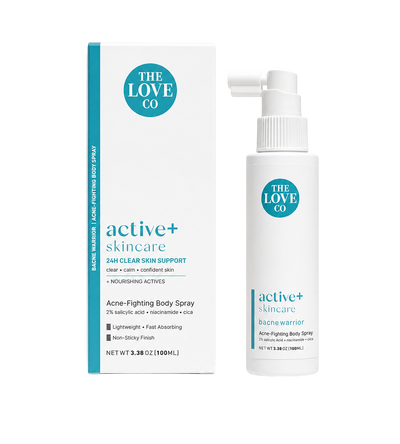
Bacne Spray – 2% Salicylic Acid Body Spray
A leave-on 2% salicylic acid body spray for back, chest, shoulder, and post-workout body acne. Designed for hard-to-reach zones, fast absorption, and daily use under clothes without a...
- Efficacy of benzoyl peroxide 5.3% emollient foam and benzoyl peroxide 8% wash in reducing Propionibacterium acnes on the back J Drugs Dermatol, 2010
- A review of the safety and efficacy of benzoyl peroxide 5.3% emollient foam in the management of truncal acne vulgaris J Clin Aesthet Dermatol
- Salicylic acid as a peeling agent: a comprehensive review Clin Cosmet Investig Dermatol, 2015
- Guidelines of care for the management of acne vulgaris (summary) American Academy of Dermatology, 2024
- Efficacy and safety of 2% supramolecular salicylic acid compared with 5% benzoyl peroxide/0.1% adapalene: a randomized split-face study Cutan Ocul Toxicol, 2019
- 2% supramolecular salicylic acid hydrogel vs. adapalene gel in mild to moderate acne: a multicenter randomized trial J Cosmet Dermatol, 2024
- Topical nicotinamide compared with clindamycin gel in the treatment of inflammatory acne vulgaris Int J Dermatol, 1995
- Topical 4% nicotinamide vs. 1% clindamycin in moderate inflammatory acne vulgaris Int J Dermatol, 2013
- ACNESIUM, the daily care for acneic skin Silab, 2020
A ritual is the smallest love you give yourself, daily.
— Hemang Jain · 14 Oct 2026